You drive out to Queen Creek on a Thursday afternoon. Forty minutes each way, plus the hour on site. The homeowner is pleasant, the yard has potential, and about twenty minutes in it becomes clear she is thinking of something around twelve thousand dollars — a paver patio and some lighting. Nothing wrong with that project. It is just not your project, and you have now spent most of an afternoon establishing it.
The information that would have saved you that drive existed. She said it, in her own words, in the chat on your website four days earlier. Nobody wrote it down.
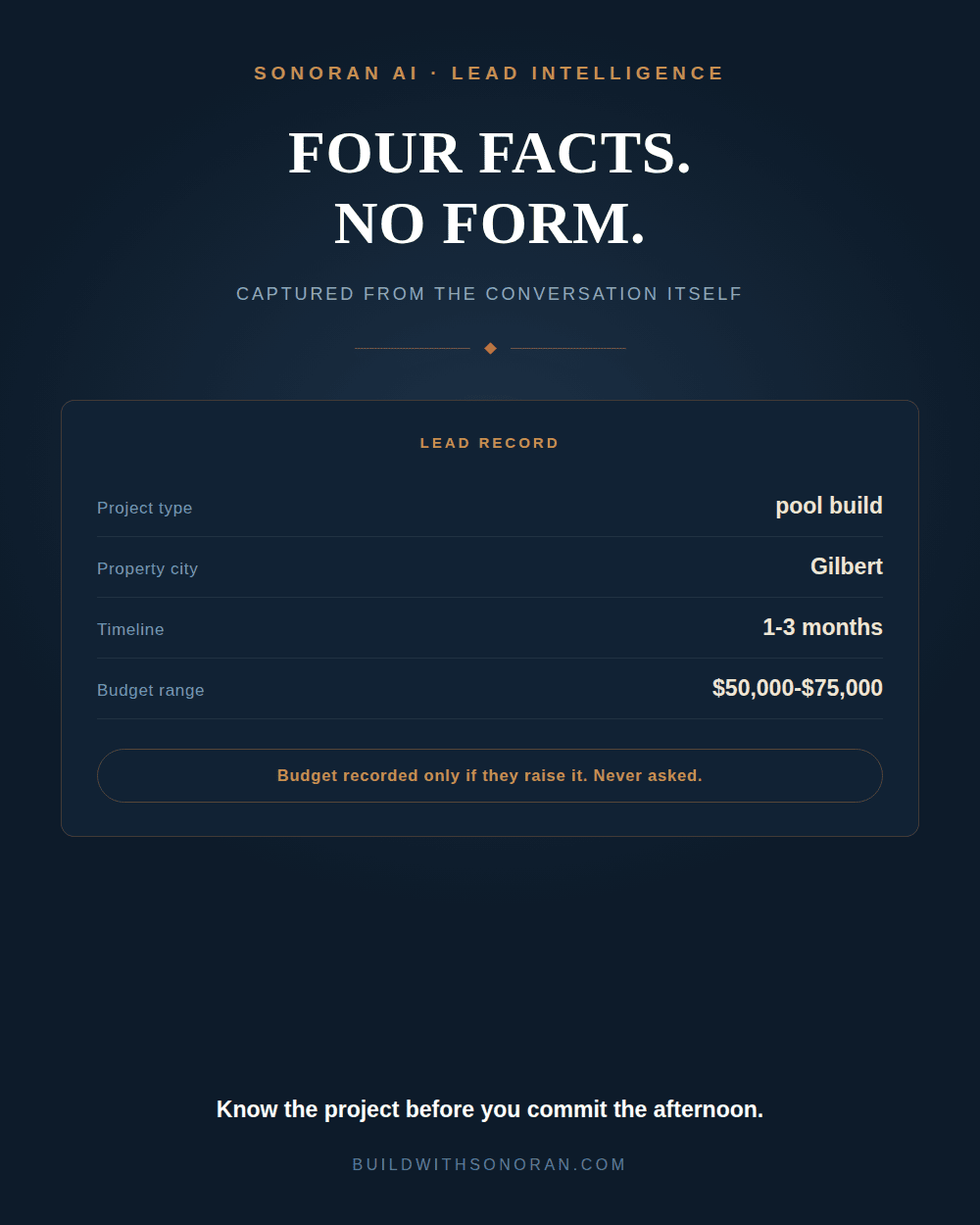
That is the gap this closes. Every inquiry that comes through your system gets four facts attached to it, pulled out of the conversation itself — not from a form the homeowner had to fill in, and not from questions you had to remember to ask.
The four things it records
What they want built. In their words, not yours — “pool build,” “landscape design,” “kitchen remodel,” “custom pools.” Free text on purpose, because a dropdown of your service categories forces a homeowner's description into whichever box is closest, and closest is often wrong.
Where the property is. Chandler, Gilbert, Queen Creek, Paradise Valley, Scottsdale — wherever they actually are. On its own that is a drive-time calculation. Across a few months it is a map of where your work is really coming from.
When they want it done. Recorded against a fixed set of bands: ASAP, one to three months, three to six, six or more, or just researching. The distinction that matters is the last one — just researching is about commitment, not distance. Someone planning a build for next spring has a real project with a far date. Someone browsing has neither. Those are different people and they get filed differently.
Roughly what they expect to spend — and this one comes with a rule.
The budget rule, which is the part worth reading
The system never asks about budget. Not softly, not late in the conversation, not at all. It records a range only when the homeowner raises the number themselves, and it never repeats a figure back to them.
That is a deliberate constraint, and it costs us data. We built it that way because asking a stranger what they intend to spend, thirty seconds into a first conversation, is the single fastest way to make a luxury buyer feel like they are being sized up. People commissioning six-figure work notice being qualified, and they resent it in a way that a homeowner buying a water heater does not.
So the field fills in when someone volunteers — “we are thinking around sixty” — and stays empty otherwise. An empty budget field is not a failure. It usually means the conversation stayed where it should have.
The bands run from under $25,000 through to $125,000 and up, with “not sure yet” as a real answer rather than a gap. The low band earns its place: under $25,000 is often the most operationally useful thing the record can tell you, because it is the one that says this is a good person with a project that is not yours, and the honest move is a short call and a referral rather than an afternoon in the truck.
What you do with four facts
You triage. On a Monday morning with nine inquiries sitting in the list, you can see at a glance which three are pool builds in Paradise Valley with a one-to-three-month window, and which two are researching a project for next year. Everyone gets answered. They do not all get answered in the same order, and they do not all get an afternoon.
Over a longer stretch, the same four fields answer questions owner-operators normally guess at. Which city actually sends you work, as opposed to which city you assume does. Whether the leads arriving in the busy season are the same shape as the ones arriving in the quiet one. Whether the project type you have been marketing is the project type people are asking for.
None of that requires you to keep a spreadsheet, because the record is written as the conversation happens.
What it is not
It is a first read, not a credit check. These are four things a stranger said in a chat window. A budget band is what someone thinks a project costs before anyone has priced it, and that number moves once you are standing in the yard. Treat the record as a reason to call one lead before another, not as a decision about whether the work is real.
It is not a substitute for the conversation. Everything here is meant to make your first call better informed. It does not make the call unnecessary, and a system that told you it did would be selling you something.
It captures what someone tells it, once. If a homeowner chats in March about a pool and comes back in June having changed her mind about the whole project, the record does not quietly rewrite itself — the earlier answers stand until someone updates them. Worth knowing if you are working leads that have been sitting for months.
It does not qualify people out. Nothing here declines a lead, deprioritises them silently, or stops replying to someone whose budget looks small. Every inquiry still gets a real answer. The record changes what you know when you pick up the phone, not who gets picked up for.
The honest summary
Four fields is not an impressive-sounding feature. What it replaces is the thing most contractors actually do, which is drive out to find out — and for a business whose scarcest resource is hours in a truck, knowing what a project is before you commit an afternoon to it is worth more than most of what gets sold as automation.
Sonoran AI builds this for luxury home-service contractors across the Southeast Valley — Chandler, Gilbert, Scottsdale, Queen Creek and Paradise Valley. It is part of the standard build, and what that costs is published in full.