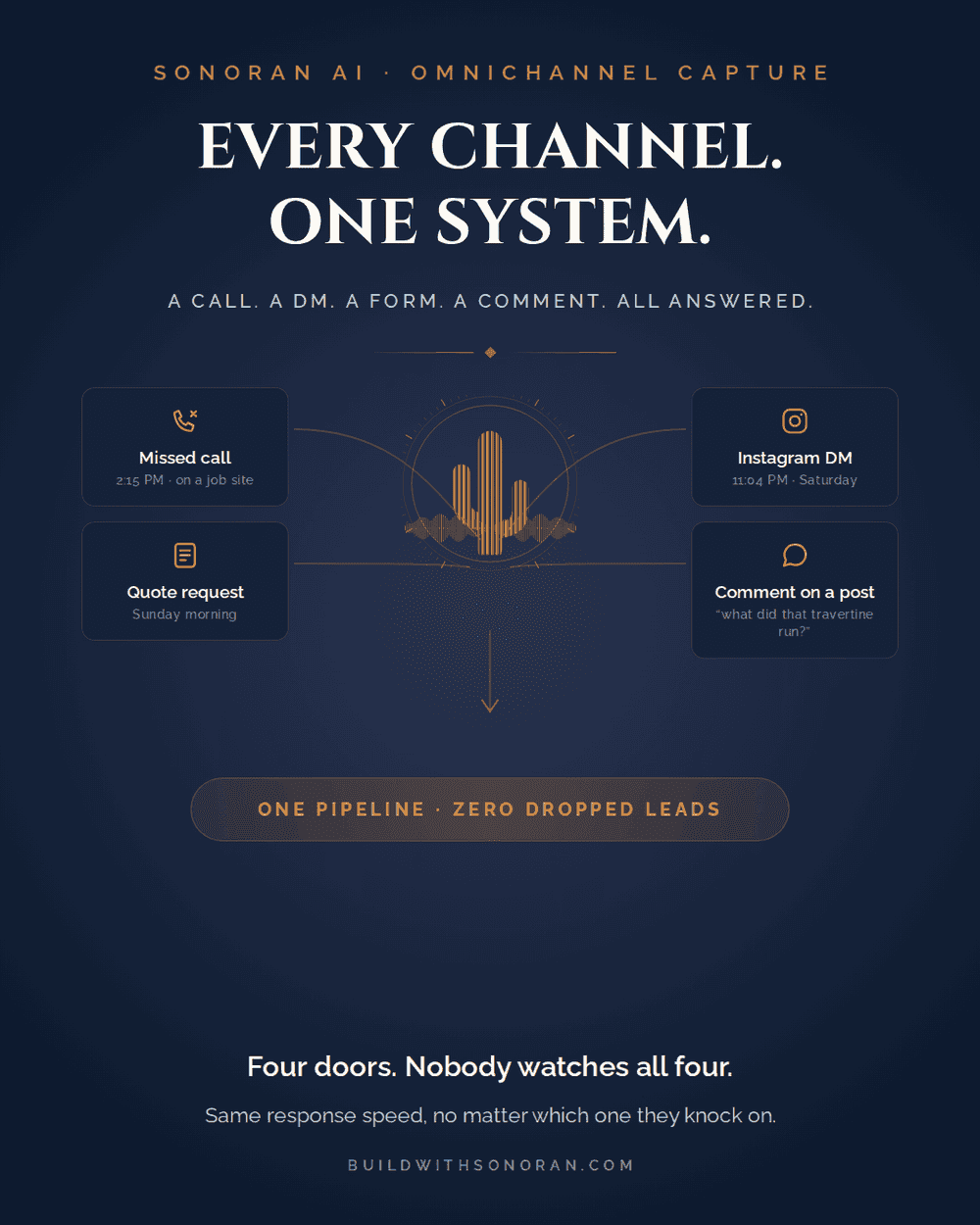
A homeowner in Paradise Valley has been thinking about her backyard for most of a year. Tuesday afternoon she texts the number off the side of your truck — “Hi, do you do full backyard builds?” Thursday night she finds your Instagram, likes four project photos, and messages asking whether you have done anything in travertine. Saturday morning she fills in the quote form on your website with her address and a paragraph about the plan.
That is one buyer and something in the neighbourhood of a hundred and eighty thousand dollars, arriving through three doors on three days. The text gets answered Wednesday. The Instagram message sits unread for nine days, because Instagram is on your personal phone. The web form goes to an address you check when you remember. Three fragments of one conversation, and nobody on your side ever realises they belong together.
A single inbox is the fix for that specific problem. Every message from every channel — text, web chat, email, Facebook, Instagram — lands in one place, grouped by the person who sent it rather than by the app it came from. It is the least glamorous thing we build, and the one owner-operators consistently underestimate until they see it.
Four doors, and nobody watches all four
Ask a contractor where leads come in and the answer is usually “the phone.” Ask them to list every place a stranger could reach them this week, and the list grows:
- Texts to your business number — the default for anyone who does not want to interrupt their own evening with a phone call.
- The chat widget on your website — someone comparing three builders at eleven at night, not ready to talk to any of them.
- Email — form fills, quote requests, the referral who was handed your address by a neighbour.
- Facebook and Instagram messages — where design-led buyers start, because they found you through photographs of work.
Four queues, four apps, four sets of notification settings, on a phone that spends the working day in a truck console. Messages get missed not because contractors are careless, but because no one monitors four inboxes while running a crew.
The failure is also invisible, which is what makes it expensive. A missed call at least shows up in your call log. An Instagram message you never opened leaves no trace anywhere you would think to look. You do not experience it as a lost project. You experience it as a quiet week.
What “one inbox” actually means
Every channel arrives in the same list. A text, a web chat, an email and an Instagram message all appear in one stream. No switching apps, no deciding which to check first.
Conversations group by person, not by channel. This is the part that does the real work. The homeowner above texts Tuesday and messages Instagram Thursday, and both land in the same thread, under her name, in order. You can see she asked about backyard builds before she asked about travertine. One conversation with one person — not two fragments from two strangers.
You reply from that one place, and it goes back out the way it came in. Answer her Instagram message from the same screen where you answered her text, and your reply arrives in Instagram. She never sees the machinery. From her side it looks like a business that keeps track of her.
Practically: a browser tab on your desktop and an app on your phone. Nothing changes about the number on your truck.
What each door is actually for
Text is the workhorse. It carries missed-call text-back — the automatic reply that goes out within seconds when a call goes unanswered — and it is where most conversations end up even when they started elsewhere. We covered that first minute in our piece on missed-call text-back.
Web chat catches the researcher: on your site at an hour when calling would feel strange, comparing you against two other builders. A chat window is low commitment in a way a phone call is not, and it converts people who would otherwise have closed the tab.
Email is the slow lane, and it carries the most detailed inquiries — the form fill with an address, a budget and three paragraphs. It is also where a lot of contractors' best leads quietly rot.
Facebook and Instagram are the messages you are most likely losing right now. Luxury outdoor living is a visual purchase: people find a pool builder by seeing a pool, and the first move after seeing one they like is to message the account that posted it. If those land on a personal phone opened on weekends, they are effectively unanswered.
Why fragmentation costs more on a six-figure project
Your buyer is shortlisting. Nobody commissions a six-figure backyard from the only company they contacted — they are working a list of three or four, usually in one evening, and who responds first shapes who gets taken seriously. The research here is thinner than the internet suggests, and we went through what the studies actually support in our piece on the five-minute window. But the one large credible audit of first-response times found an average first response of roughly forty-two hours across 2,241 companies, and much better qualification odds for firms responding inside an hour.1 The bar is not high. It is just consistently missed.
These conversations are also long. A backyard project runs over weeks — questions about materials, a request for similar work, a pause while a spouse is consulted, a return three weeks later. Every touch is a chance for the thread to break if it lands in a different app than the last one. When a homeowner comes back after a month and has to re-explain who she is, you have handed a competitor a reason to look more organised than you.
What this does not mean
We do not run your social media. We do not post to your accounts, write captions, plan content, or manage your following. Nothing about your public presence changes. What we connect is the inbound side only: messages people send you get captured, answered and followed up. If you want someone to grow your Instagram, that is a different service from a different vendor, and we will say so rather than pretend otherwise.
It does not answer for you unless you switch that on. The inbox is where messages arrive. Automated first replies and follow-up sequences sit on top of it, and you decide which channels they run on. Plenty of owners want automation on texts and nothing at all on Instagram. That is a setting, not an argument.
It does not import your history. Conversations accumulate from the day a channel is connected. Two years of past Instagram messages stay where they are.
Google Business Profile messaging is not part of this, because it no longer exists. Google shut its Business Profile chat feature down, so the Google integration handles reviews and call tracking rather than messages. If a vendor is currently offering to route your Google messages into their inbox, that is worth a hard question.
What connecting it involves
Texting your business number is the longest pole, because business texting in the United States requires carrier registration — the A2P process — and the carriers take as long as they take. That is the one part of the timeline nobody can promise, which is why our go-live clock starts at carrier approval rather than at signing. The web chat widget is a snippet on your site, minutes rather than days. Facebook and Instagram you authorise from your own accounts; we never need your password. Email routing points inbound form fills at the same conversation view.
All of it is part of the standard build. There is no charge for connecting a channel and no tier where the inbox is better — what the build costs is published in full on our pricing page, including what is not included.
The honest summary
A shared inbox does not win you work. It does not design a backyard, price a job, or replace the walkthrough where you actually close. What it does is make sure every person who tried to reach you is visible in one list, in order, with their history attached — so answering them is something you can do between jobs rather than something you intend to do later.
For a business where one missed conversation is a six-figure project and the referrals that would have followed it, that is not a small piece of infrastructure.
Sonoran AI builds this for luxury home-service contractors across the Southeast Valley — Chandler, Gilbert, Scottsdale, Queen Creek and Paradise Valley.
Sources
Every figure in this article traces to a named primary study. Where a commonly repeated statistic could not be traced to an original source, we left it out rather than repeat it.
- Oldroyd, J.B., McElheran, K. & Elkington, D., “The Short Life of Online Sales Leads,” Harvard Business Review, March 2011. Audit of first-response times at 2,241 U.S. companies.