A homeowner in Gilbert asks about a backyard build on a Tuesday. You answer within the hour, she replies once, and then nothing. No no, no not yet, just silence.
Most contractors follow up twice. A text on Thursday, maybe a call the following week, and then the lead quietly moves to the pile of people who were probably never serious. It feels like the respectful thing to do. Nobody wants to be the vendor who will not take a hint.
But the hint usually is not there. She is waiting on a spouse who travels, or on a bonus in March, or on a number she has not asked you for because she does not want to seem like she is shopping. What she stopped doing was replying. What she did not do was decide.
Why follow-up gets abandoned
The reason owner-operators stop is not laziness — it is that they have no script, so every message has to be invented, and an invented follow-up message almost always comes out as some version of “just checking in.”
That sentence is the problem. It contains no information, asks the homeowner to do the work of restarting the conversation, and signals that you are counting the days since she last replied. Send it three times and you have taught her that your messages are safe to ignore.
The fix is not more persistence. It is that every message has to be worth opening on its own, whether or not she ever replies to it.
What actually runs over the two weeks
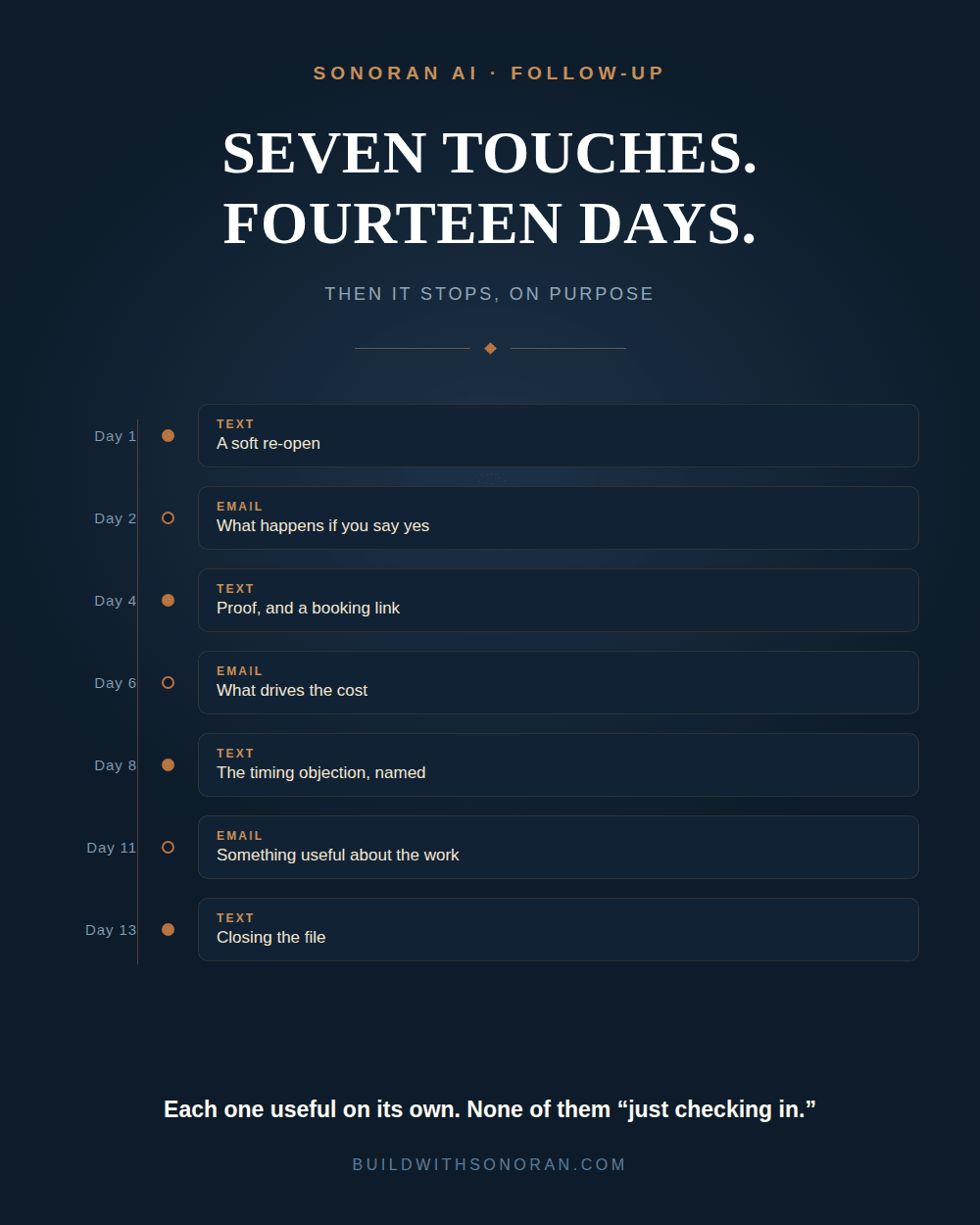
Seven messages across roughly fourteen days, alternating between text and email, on a cadence that starts close and stretches out: a day, then two, two, two, three, two. Nothing is sent outside business hours, and nothing is sent on a Sunday.
The shape matters more than the timing. Each one does a different job:
- A soft re-open. Short, text, no ask. It exists to say the door is open without demanding anything — ours opens with a line about not wanting the project to stall out on our end.
- What actually happens if you say yes. Email. The consultation length, that nobody signs anything on the call, that a written scope and price follows. Most hesitation at this stage is not about money, it is about not knowing what the next step commits them to.
- Proof, and a booking link. Text. One concrete thing, and a way to act on it.
- What drives the cost. Email — and it deliberately refuses to quote a number, then explains why. Scope, complexity and timeline are named as the three drivers. Anyone who gives a real price by email is guessing, and homeowners know it.
- The timing objection, named out loud. Text. If the holdup is timing rather than interest, say so and we will leave you alone until then. This one earns more replies than anything else in the sequence, because it gives the homeowner a way to answer that is not yes and is not no.
- Something useful about the work itself. Email, and the last one. Ours is advice about what to ask any builder you are considering — what happens when something goes wrong, not if.
- Closing the file. Text. We say plainly that we are going to stop, and that there are no hard feelings.
The last message is the one that works
Message seven consistently produces replies, and the reason is not a trick. It removes the pressure. As long as a sequence is running, the homeowner owes you an answer she has been avoiding. The moment you say you are closing the file, the debt disappears — and a good number of people answer honestly, because it finally costs them nothing.
Some of those replies are “we went with someone else,” which is useful. Some are “sorry, my husband has been travelling, can we talk next week,” which is a project. You do not get either one by going silent at day four.
Why fourteen days and not forever
Because the alternative is a system that never lets anyone go, and that is how a business ends up in a reputation it cannot see. The sequence has an end. It stops on its own, whether or not anyone replies.
It also stops the instant she answers. A reply at any point pulls her out of the automated run and puts the conversation in front of you as a live thread — the messages are there to keep a door open, not to talk over someone who has walked through it.
On response speed generally, the evidence is thinner than the internet suggests, and we went through what the studies actually support in our piece on the five-minute window. The one large credible audit of first-response times found firms responding inside the first hour had meaningfully better qualification odds than those that did not.1 That research is about the first touch, not the fourteenth — and it is worth being clear that nobody has published a credible study telling you the right number of follow-ups for a six-figure landscape build. What we can tell you is the shape we run and why each message is in it.
What it does not do
It does not rescue a bad fit. If the project is not one you should be doing, seven well-written messages will not change that — they will just get you a politely declined bad fit two weeks later.
It does not pester. Seven messages over fourteen days, business hours only, each one useful on its own, ending with an explicit exit. If that reads as too much for your market, the cadence is yours to change.
It does not replace you. The moment someone re-engages, they are talking to you. Everything above exists to get the conversation back to that point.
The honest summary
The leads you already paid for are the cheapest ones you will ever get. A homeowner who contacted you once has already done the hard part — she found you, decided you were worth an inquiry, and told you what she wants. Losing her to silence on day four is the most expensive habit in a contracting business, and it is the easiest one to fix, because it does not require you to be better at sales. It requires the messages to go out when you are on a job site and not thinking about her at all.
Sonoran AI builds this for luxury home-service contractors across the Southeast Valley — Chandler, Gilbert, Scottsdale, Queen Creek and Paradise Valley. What it costs is published in full.
Sources
Every figure in this article traces to a named primary study. Where a commonly repeated statistic could not be traced to an original source, we left it out rather than repeat it — and where no credible study exists at all, as with optimal follow-up counts, we say so rather than invent one.
- Oldroyd, J.B., McElheran, K. & Elkington, D., “The Short Life of Online Sales Leads,” Harvard Business Review, March 2011. Audit of first-response times at 2,241 U.S. companies.