Here is the situation every contractor in the Southeast Valley knows by heart. You are eleven feet up, or elbow-deep in a trench, or walking a client through tile samples. The phone rings in your truck. By the time you get to it, there is a missed call from a number you don't recognise.
You'll call them back. Tonight, probably, or first thing tomorrow. And a meaningful share of the time, it won't matter, because they've already talked to somebody else.
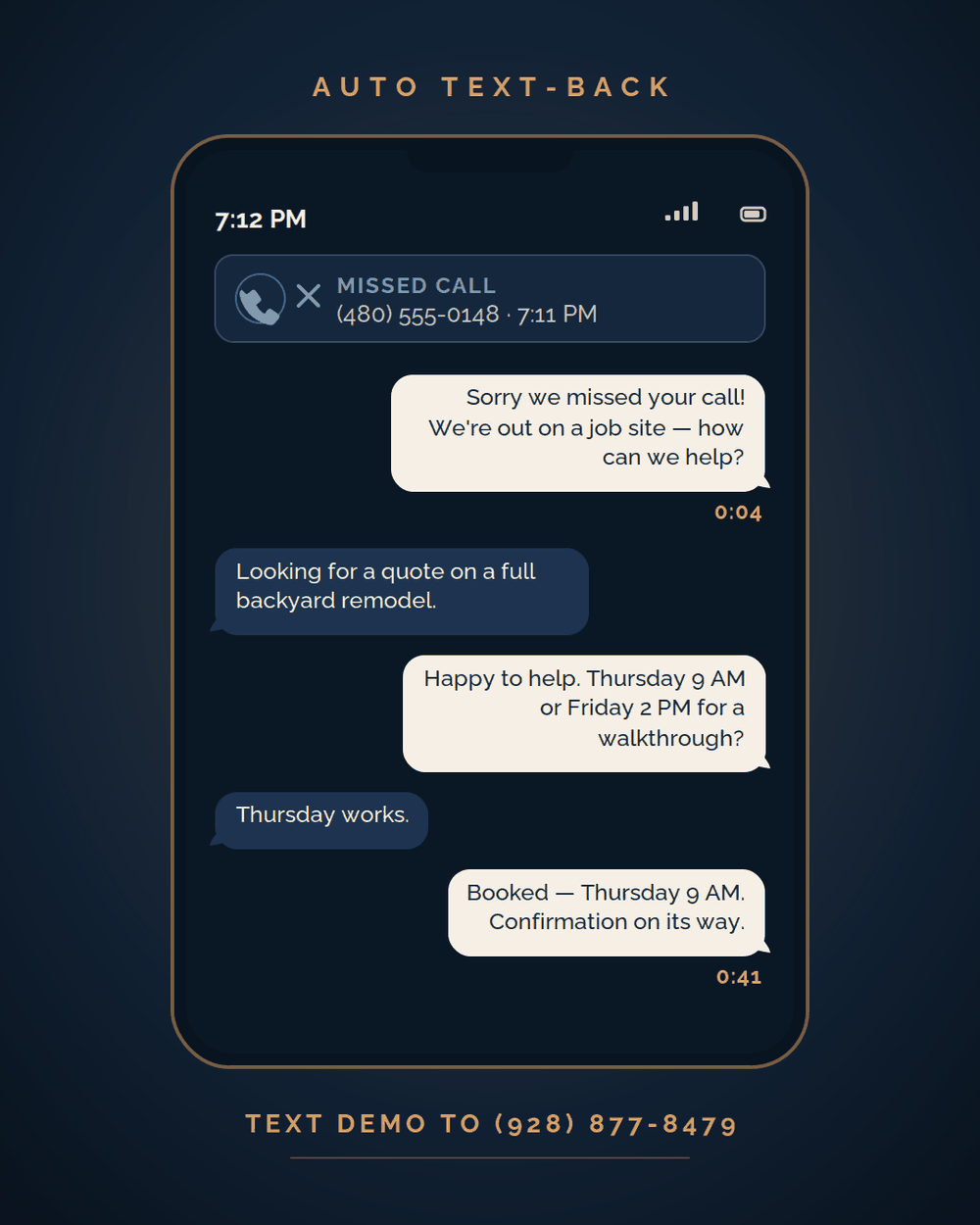
Missed-call text-back is the simplest fix for that specific problem. The moment a call to your business goes unanswered, the caller gets a text — automatically, within seconds — that acknowledges the miss, introduces you, and asks what they need. No voicemail. No callback queue. The conversation starts while they are still holding the phone.
What actually happens, step by step
The mechanism is less clever than it sounds, which is the point. Nothing here depends on the homeowner doing anything unusual.
- The call comes in and isn't answered. Could be after hours, could be that you're on a job site, could be that you're already on another call.
- A text goes out within seconds. It comes from your business number, so it lands in a thread the homeowner recognises. It says you missed them, says why in one line, and asks what they're working on.
- They reply, and the conversation continues. This is the part people underestimate — most callers do reply, because replying to a text costs them nothing and doesn't require them to be free to talk.
- The system qualifies and books. What kind of project, roughly what scope, which city. Then it offers real openings from your calendar and confirms one.
- You get the transcript. The whole exchange is waiting when you come off the job, with an appointment already on the calendar.
You can watch that sequence happen on our own line rather than take our word for it — text the demo number and it will answer you exactly the way it would answer your customers.
Why text, and not a callback
Texting isn't better than calling because of some magic engagement number. It's better here for three structural reasons.
It's asynchronous. A callback requires the homeowner to be free at the moment you happen to dial. A text doesn't. They can answer between meetings, at a stoplight, while the kids are eating dinner. You are no longer trying to catch them.
It leaves a written record. When someone is comparing three builders for a six-figure backyard, a thread they can scroll back through beats a voicemail they half-remember. Your scope questions and your answers are sitting in their phone when they sit down to decide.
It removes the awkwardness of the callback. Returning a call two hours later means opening with an apology and hoping they still care. Replying in four seconds means opening with a question about their project.
You'll see a statistic in a lot of articles about text messaging claiming a 98% open rate. We don't use it, because it isn't measurable — SMS has no read receipts and no tracking pixel, so nothing in the system can report whether a text was opened. The figure circulated in the early 2000s and has been repeated ever since without a traceable source.
The argument for text-back doesn't need it. Speed and convenience carry the case on their own.
What the research does support
There is one body of evidence here that holds up, and it's about speed rather than channel.
In 2011, researchers from Harvard Business Review audited how quickly 2,241 U.S. companies responded to inbound web enquiries. Among firms that responded at all within thirty days, the average time to first response was 42 hours. Not minutes. Hours.
The same research found that firms attempting contact within an hour of the enquiry were roughly seven times more likely to qualify the lead than those that tried even an hour later — and more than sixty times more likely than those who waited a day.
Firms that tried to contact potential customers within an hour of receiving a query were nearly seven times as likely to qualify the lead as those that tried to contact the customer even an hour later. Harvard Business Review, March 2011
Two honest caveats, because they matter. That study measured qualifying a lead — reaching a real decision-maker in a meaningful conversation — not closing revenue. And it's fifteen years old. What it establishes is the shape of the curve: responsiveness decays fast, and the decay is steep at the front. It does not tell you what a pool build is worth.
Where this fits for a luxury contractor
The maths is different for you than for a business selling something small. A landscape design-build or a custom pool runs well into six figures, and the homeowner considering one is almost never contacting only you. They are working a short list, usually in a single sitting, usually at night.
In that context the cost of a missed call isn't a lost conversation. It's a lost project, plus the referrals that would have come out of it. And it happens invisibly — a missed call that never becomes a callback leaves no trace in your pipeline at all. You simply never know it happened.
That's the case for automating the first response rather than intending to get to it later. Not because you're bad at following up, but because the window closes while you're doing the work you were hired to do.
What it doesn't do
Text-back handles the first minute. It is not a salesperson, and it shouldn't pretend to be one. It won't talk a hesitant homeowner into a project, it won't price a job, and it won't replace the walkthrough where you actually win the work.
What it does is make sure the walkthrough gets booked — that the person who called at 7:11 on a Tuesday is on your calendar by 7:12, instead of on somebody else's by Thursday.
Sources
Every figure in this article traces to a named primary study. Where a commonly repeated statistic could not be traced to an original source, we left it out rather than repeat it.
- Oldroyd, J.B., McElheran, K. & Elkington, D., “The Short Life of Online Sales Leads,” Harvard Business Review, March 2011. Audit of first-response times at 2,241 U.S. companies.